Four Years On: Revisiting the US Department of Energy’s 2022 View of Vehicle-Integrated Solar
Building on our recent look at European research highlighting the growing potential of solar panels for commercial vehicles and other forms of vehicle-integrated solar, findings published by the US Department of Energy provide another perspective, focusing on what is needed to support wider real-world adoption.
In our previous article, we explored the European SolarMoves research into the potential contribution of vehicle-integrated solar to future transport. Commissioned by the European Commission’s Directorate-General for Mobility and Transport, the research suggested widespread adoption could reduce demand on Europe’s electricity grid by 15.6TWh annually.
Research published by the US Department of Energy (DOE) adds another dimension to the international conversation around vehicle-integrated photovoltaics (VIPV).
Back in 2022, the DOE‘s Solar Energy Technologies Office and Vehicle Technologies Office sought views from fleet operators, manufacturers, research institutions, and other industry stakeholders on the opportunities and challenges associated with vehicle solar. The findings looked beyond the potential of the technology to consider what might be needed to support wider adoption.
At the time, respondents identified commercial trucks and trailers as one of the biggest opportunities. They pointed towards auxiliary power as a primary use case and highlighted requirements around weight, flexibility, vibration, reliability, safety, standards and system integration.
These weren’t predictions about what commercial vehicle solar would eventually look like. They were the issues the industry believed needed to be addressed.
Four years on, we can compare them with what we’re actually seeing in commercial deployment.
Commercial Vehicle Solar Emerged as a Key Opportunity
One of the clearest themes from the DOE consultation was the potential for solar in commercial vehicle applications. Commercial trucks and trailers were generally viewed by respondents as representing the largest market opportunity for vehicle solar, with utility vehicles, transport refrigeration units, buses and local delivery fleets among the applications identified as particularly promising.
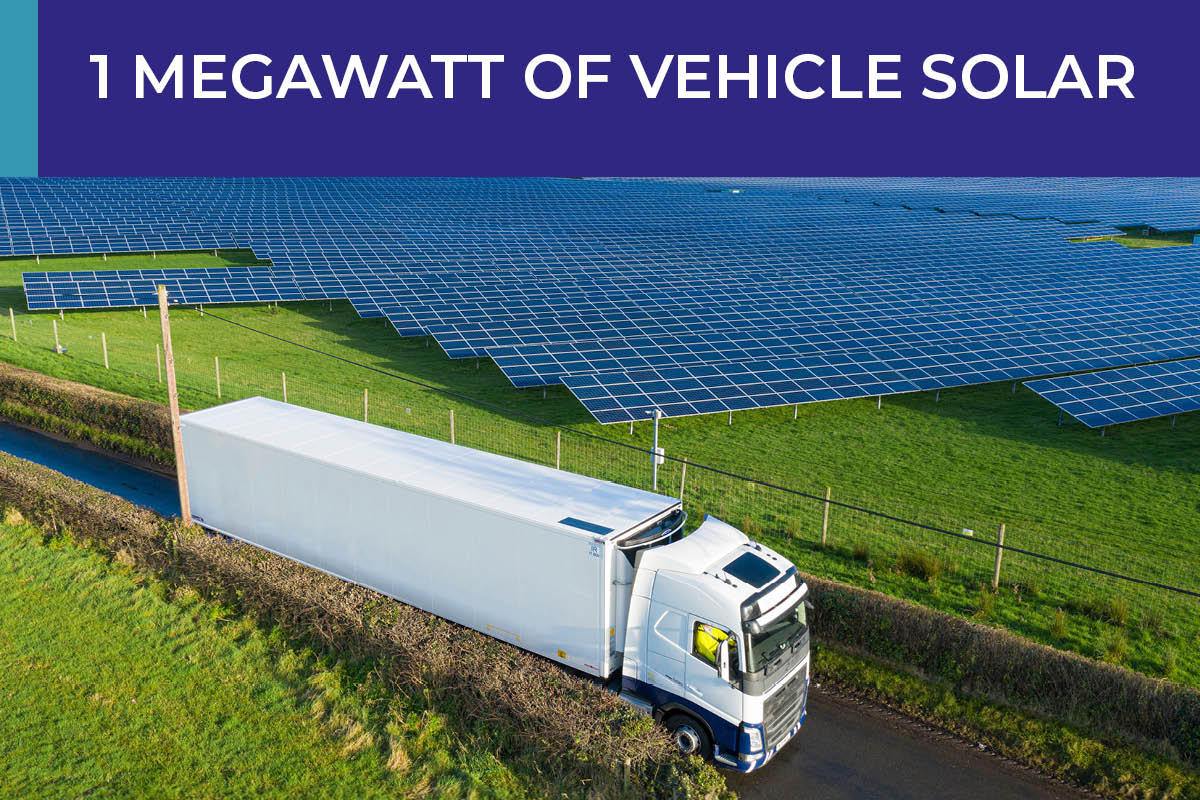
This strongly reflects what Genie Insights has seen in practice. Commercial vehicle solar has been our focus since our first fleet trial in 2019. What began with a single trial has since grown into around 16,000 solar panels deployed across vans, trucks and refrigerated trailers.
That growth has given us a front-row view of increasing market acceptance of vehicle solar and, importantly, of the applications where it can deliver the greatest operational value.
The DOE consultation also identified supporting auxiliary electrical loads as one of the two primary use cases for vehicle solar, alongside contributing energy towards vehicle propulsion.
Again, there is a direct correlation with our experience. While vehicle-integrated solar is now often discussed in the context of extending EV range, the majority of systems we currently supply have a different purpose: maintaining the vehicle’s 12V battery and helping to offset the parasitic drain created by auxiliary equipment.
Telematics, cameras, tracking, safety and communications systems can continue to draw power even when a vehicle isn’t being driven. As commercial vehicles become increasingly connected and sophisticated, we are seeing this become a growing challenge for fleet operators.
Solar panels for commercial vehicles can provide a continuous source of supplementary energy to help replenish the power being drawn from the battery, maintain its state of charge and reduce the risk of battery-related operational issues.
The Value of Vehicle Solar Goes Beyond Energy Generation
One particularly interesting observation within the DOE findings was that the value of vehicle solar can extend beyond simply the amount of electricity generated.
For commercial vehicle operators, solar energy can be used to support a range of vehicle functions, from maintaining batteries and supporting auxiliary equipment to reducing demand placed on conventional vehicle power sources.
This closely reflects Genie Insights’ approach. Rather than selecting an off-the-shelf panel based on its rated wattage, we start with the problem the fleet operator is trying to solve and model the system around the vehicle’s actual energy requirements. Where appropriate, we also undertake real-world trials to validate the predicted outcome before wider deployment.
The real value of solar therefore isn’t necessarily the monetary value of the electricity generated, but the operational benefits it can deliver. By helping to maintain a healthier battery state of charge, solar can help protect battery health and extend battery life, reducing the financial and environmental impact of premature battery replacement, while also minimising the risk of battery-related vehicle downtime.
Putting a Solar Panel on a Commercial Vehicle is Only the Beginning
The DOE consultation also highlighted some of the practical challenges that differentiate vehicle solar from conventional stationary photovoltaic installations, such as those traditionally found on buildings.
Respondents identified weight, flexibility, vibration resistance, reliability, lifetime, maintenance and safety among the key requirements, together with the need for appropriate testing and standards.
Solar technology installed on a vehicle must contend with changing temperatures and weather, and rapidly changing levels of sunlight and shading while continuing to perform reliably.
Many of these requirements reinforce why we believe CIGS is particularly well suited to commercial vehicle applications. Its fundamental characteristics address several of the challenges identified by respondents: it is lightweight, flexible enough to follow the contours of a vehicle surface and, thanks to its glass-free construction, highly robust and shatter-resistant, while also performing well in the variable light and shading conditions encountered by vehicles in everyday operation. Read more about the advantages of CIGS solar technology for commercial vehicles here.
The CIGS solar panel at the heart of our system is manufactured in the UK by MIPV and has its origins in building-integrated photovoltaics, bringing with it an established foundation of testing and certification, including stringent fire-performance requirements.
We’ve then built on that foundation for the commercial vehicle environment. Genie Insights has invested significantly in testing, certification and product assurances specifically for commercial vehicle applications, designing the complete system and selecting each component specifically for the demands of transport. The system is tested against internationally recognised standards covering areas including vibration and mechanical shock, extreme environmental conditions, electrical safety, weather resistance and the strength and durability of the panel bonding system.
Our MPPT charge controller is ECE R10 certified for electromagnetic compatibility, making it suitable for integration into type-approved vehicle builds and conversions.
But our assurance process doesn’t stop with the panel or charge controller. We apply the same rigorous approach across the complete kit, including cables and connectors, ensuring each is appropriately specified and validated for its role within the system. And installation quality is equally important. We apply stringent installation standards, including installer training, defined installation procedures, sign-off and quality checks, to ensure the integrity of the solution is maintained once fitted to the vehicle.
Our approach is therefore to provide an engineered and validated commercial vehicle solar solution, rather than a collection of individually sourced components. From product selection and system design through to installation and quality assurance, every element is considered around the realities of life on a working vehicle, helping to minimise operational and compliance risk throughout its service life.
The concerns highlighted through the DOE consultation therefore strongly reinforce the approach we have taken from the outset: putting a solar panel on a vehicle is relatively straightforward; engineering and installing a safe, reliable and credible commercial vehicle solar solution requires considerably more.
Four Years Later, How Far Have We Come?
The DOE’s RFI captured what industry stakeholders thought vehicle solar needed back in 2022. Four years later, many of those requirements remain highly relevant. What has changed is the amount of commercial experience now available.
Since our first fleet trial in 2019, we have supplied more than 16,000 solar panels across commercial vans, trucks and trailers. We’ve seen where solar works, how systems need to be specified around different vehicle applications and what happens when they move from controlled trials into fleet-wide deployment.
So many of the issues raised in the DOE consultation in 2022 mirror the areas we’ve spent the intervening years working on, from selecting the right technology to creating what we believe is the blueprint for transport solar testing and accreditation.
There is still plenty of development ahead for vehicle-integrated solar, but four years on from the DOE’s RFI, commercial vehicle solar is no longer just an opportunity being discussed. Thousands of systems are already out there doing a job on working vehicles every day.
Could Solar Help Solve an Energy Challenge Within Your Fleet?
Whether you are looking to maintain 12V or 24V vehicle batteries, add supplementary power, power onboard systems, or explore a new commercial vehicle solar application, our team can assess the requirement, model the potential solution and determine whether solar can deliver the right outcome.
Talk to Genie Insights about your commercial fleet’s energy requirements.