What Is the Difference Between Solar Trickle Charging and Autonomous Power?
There are several reasons for fitting solar panels to commercial vehicles and transport equipment, and it’s not always about directly “powering” equipment. The most common application is solar trickle charging, where solar is used to maintain battery charge. Solar can also provide supplementary power to reduce demand on another power source or, in some applications, provide fully autonomous power.
Solar Trickle Charging in Refrigerated Transport
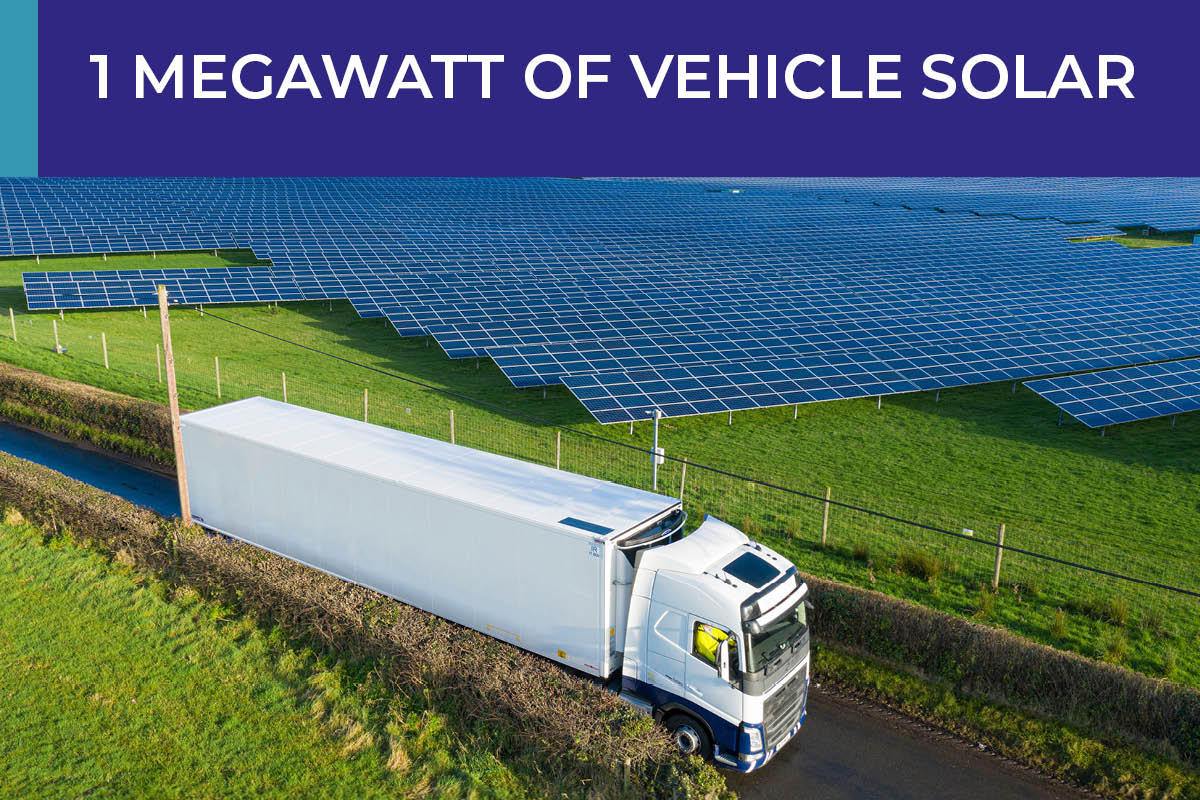
We launched our first solar product in 2020 with a solution for the refrigerated transport sector – a high voltage 50w panel that connects to the fridge battery and trickle charges it to help prevent the common problem of flat batteries. This is still our most popular solution, but since then we have supplied a number of similar solutions for different types of transport equipment.
From Refrigerated Transport to eLCVs
The battery-maintenance principle first proven in refrigerated transport has since evolved into other commercial vehicle applications, most notably electric light commercial vehicles (eLCVs).
While an eLCV is powered by a high-voltage traction battery, it still relies on a conventional 12V auxiliary battery to operate many of the vehicle’s critical systems. If the 12V battery becomes discharged, the vehicle can become inoperable even when there is charge available in the main traction battery.
Our eLCV solar solution applies the same fundamental principle used in refrigerated transport: harvesting available daylight to maintain a critical battery, offset ongoing electrical loads and reduce the risk of battery-related downtime.
This evolution demonstrates how Vehicle-Integrated Photovoltaics (VIPV) can be adapted to solve different power challenges across commercial vehicle applications.
Trickle charge applications aren’t typically about fuel saving or reducing CO2. While there might be a small saving, the benefits are primarily enhanced fleet reliability and improved battery health. Of course, by protecting the battery you can reduce the number of battery replacements required over the lifetime of the equipment so you could say there is an environmental benefit in that. Any fuel saving achieved is a positive secondary benefit but it’s very hard to measure.
From Trickle Charging to Supplementary and Autonomous Power
Larger solar systems can provide supplementary or, in some applications, fully autonomous power for onboard equipment. This can involve larger solar arrays, potentially covering much of the available roof area of a trailer or vehicle body, to generate significantly more energy.
Applications can include refrigeration equipment, air curtains, camera systems and electrically powered ancillary equipment such as tail lifts and lifting decks. By providing energy that would otherwise need to come from the vehicle or another power source, larger solar systems can also contribute to fuel and CO₂ savings.
Waste and recycling vehicles are a good example. We have successfully deployed larger solar systems with local authorities, where available roof space can be used to generate energy for onboard ancillary equipment. This reduces demand on the vehicle’s alternator, helping to reduce fuel consumption and associated emissions.