European research highlights growing role of vehicle-integrated solar in fleet electrification journey
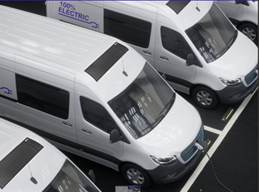
European research highlights growing role of vehicle-integrated solar in fleet electrification journey
· Solar could reduce overall European electricity demand equivalent to powering more than four million homes
· Genie Insights is seeing increased demand from UK fleets to fit solar to vans, trucks and trailers
· Solar addresses growing challenge of increasing demand on vehicle battery power from ancillary systems and equipment
Recent European research commissioned by the European Commission’s Directorate-General for Mobility and Transport (DG MOVE) has highlighted the significant potential of vehicle-integrated solar technology.
And with over 15,000 solar panels fitted across vans, trucks and refrigerated trailers throughout the UK and Europe, Genie Insights has welcomed the research findings.
The findings reinforce a principle that Genie is already seeing embraced by UK commercial vehicle and trailer fleets that the future of fleet electrification is not simply about larger batteries and more charging points, it is also about generating and managing energy more intelligently on the vehicle itself.
The findings come from the SolarMoves project, which was commissioned to better understand how vehicle-integrated photovoltaic (VIPV) technology could help reduce charging demand and ease pressure on Europe’s electricity grids as transport continues to electrify. It suggests widespread vehicle solar adoption could reduce demand on Europe’s electricity grid by 15.6TWh (Terawatt-hours) annually – enough electricity to power more than four million homes for a year.
Delivered by a consortium led by TNO, an independent Dutch applied research organisation, the project examined the potential contribution of vehicle-integrated solar across a range of vehicle types and operating environments.
As onboard electrical demands continue to increase, fleet operators are facing a growing challenge with vehicle systems such as telematics, cameras, safety equipment, refrigeration units and connected technologies increasing demands on vehicle batteries. At the same time, operators are under pressure to maximise vehicle uptime, improve operational efficiency and reduce energy consumption.
Vehicle-integrated solar offers a practical way to address these challenges by capturing available energy directly from the vehicle’s surface and using it to support onboard electrical systems.
A specialist povider of vehicle-integrated solar and onboard energy solutions for commercial vehicle fleets, Genie Insights has seen first-hand how onboard solar can support battery health and help fleets such as Network Rail and BT manage growing onboard energy demands. They appreciate that reducing energy demand at source and making better use of available renewable energy have an important role to play to support their ambition to reduce vehicle emissions.
Matt Reeve, Managing Director of Genie Insights said: “Electrification is often framed as a challenge that can only be solved through larger batteries and expanded charging infrastructure. While those elements are important, we believe there is an equally important opportunity to generate energy where it is needed.
“Commercial vehicles spend every day exposed to daylight and equipped with vehicle-integrated solar allows operators to capture some of that energy and put it to work supporting onboard systems, improving reliability and reducing unnecessary demand on vehicle batteries.
“Having deployed more than 15,000 systems across commercial fleets it’s encouraging to see independent European research highlighting the potential of an approach that many UK fleets are already successfully adopting today.”
The significance of the SolarMoves findings is not simply the scale of the potential energy generation. It represents a fundamental shift in how vehicles are viewed within the energy ecosystem.
As vehicle technology continues to evolve, Genie Insights believes that integrated energy solutions combining solar generation, battery technology and intelligent energy management will play an increasingly important role in supporting reliable, efficient and resilient fleet operations.